KEY TAKEAWAYS
- Visa uses 4 with 13, 16 or 19 digits.
- Security code: 3 digits (back).
- Format checks are free; live status needs an issuer check.
- Validate locally first to avoid spending checks on bad rows.
- Errors in Visa card checking are free: no classification, no charge.
- Fund before long runs; interrupted Visa card checking runs are the expensive kind.
Every network has its own number format — Visa included. This page covers the format facts you need for correct validation, and how to verify live status beyond the format.
Visa format at a glance
| Property | Value |
|---|---|
| Prefix / IIN ranges | 4 |
| Number length | 13, 16 or 19 digits |
| Security code | 3 digits (back) |
| Checksum | Luhn (mod 10) |
What is specific about Visa
- Visa is the most widely accepted network, so Visa BIN ranges dominate most card lists — expect the bulk of any list to be Visa.
- Visa Electron and V PAY cards may behave differently in verification: some respond only to account-status checks rather than authorisation-style probes.
- The 19-digit Visa format exists mainly for certain co-branded and UnionPay-adjacent products; do not hard-code 16.
Validating and verifying
Step one is always free: validate format with the Luhn validator and identify the range with BIN lookup. Step two is a live check through the CC checker or the CVV checker flow, which asks the issuer whether the account is active. Errors are not billed, dead results are final, and unknown results should be retried on a fallback CC gateway.
Bulk Visa lists
Mixed-brand lists work fine: the checker validates each row, routes it through the gateway and streams results. Read the bulk workflow before large runs.
Visa is the broadest card brand in circulation, and it is also the best-covered on virtually every verification gateway. That coverage hides a complication: Visa numbers are issued by thousands of banks and fintech programs, and each issuer applies its own risk rules to authorization-shaped requests. The brand tells you the network; the issuer decides the answer.
For Visa lists, the failure modes that matter are format-related — expiry placement and CVV requirements differ per route — and issuer-related, where one bank answers confidently and another challenges. BIN reference data separates the two by identifying the issuer before the check runs.
Checking Visa cards in practice
A pilot batch of Visa cards before a full run is the cheapest way to confirm coverage. Coverage for Visa is not uniform across gateways; confirm the route before committing a large list. Format rules matter for Visa: prefix, length and security-code conventions must match the gateway before submission. Cross-border Visa traffic behaves differently from domestic traffic, with more unknowns on the former. Remember it the next time Visa card checking produces an ambiguous answer.
Visa ranges by card type
| Card type | Ranges |
|---|---|
| Credit | 56,860 |
| Debit | 42,896 |
| Charge card | 14 |
Where Visa ranges are issued
| Country | Ranges |
|---|---|
| UNITED STATES | 51,436 |
| RUSSIAN FEDERATION | 2,885 |
| UNITED KINGDOM | 2,472 |
| FRANCE | 2,317 |
| BRAZIL | 2,174 |
| INDIA | 2,116 |
| SPAIN | 1,927 |
| JAPAN | 1,861 |
The BIN layer behind Visa card checking
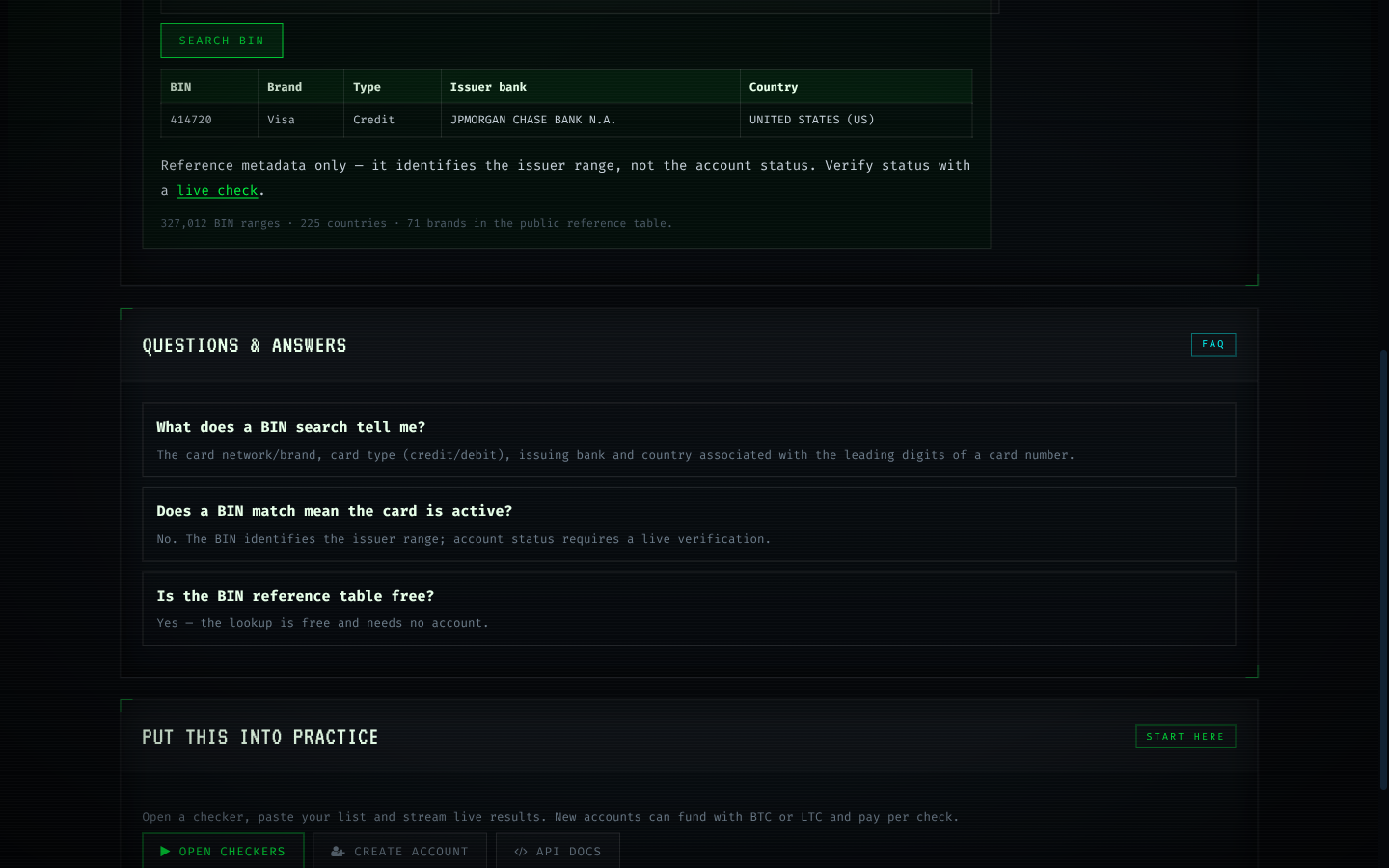
The reference table holds hundreds of thousands of issuer ranges, and the tools expose it without any account-status claims. Issuers move portfolios between banks and reissue ranges, so BIN data ages and should be refreshed from maintained sources. Six digits usually identify the institution; eight add the program or product level on many ranges. Because BIN data is public reference material, it is safe to cache, but it should be re-validated periodically. The habit costs nothing and removes a recurring class of mistakes.
Visa card checking: example issuer records
| BIN | Type | Issuer | Country |
|---|---|---|---|
400000 | Credit | INTL HDQTRS-CENTER OWNED | UNITED STATES |
400001 | Credit | INTL HDQTRS-CENTER OWNED | UNITED STATES |
400002 | Credit | RIVER VALLEY CREDIT UNION | UNITED STATES |
400003 | Credit | VISA U.S.A. INC. | UNITED STATES |
Putting Visa card checking to work
Validate checksums and expiry dates before any paid request; the free browser tools exist precisely so malformed rows never reach a provider. Watch two numbers over time: the classified rate and the error rate. Together they explain almost every surprise in monthly spend. Run one primary gateway with a fallback route. When the primary degrades, re-run only the unclassified remainder on the fallback. For recurring workloads, schedule the run before the moment the answer is needed — ahead of a billing cycle, a payout batch or an onboarding window. The habit costs nothing and removes a recurring class of mistakes.
Interpreting outcomes in Visa card checking
A live answer is evidence about the account, not a guarantee about a specific future transaction; issuer rules can change between the check and the charge. A result is only as fresh as its timestamp. High-value decisions should use checks that ran close to the moment of the decision. Two metrics describe any run: how many cards classify, and how long the pass takes. Everything else is commentary. The honest reading of unknown is "no answer yet". The card is neither good nor bad, and the remedy is a different route, not a repeat of the same one. That single habit separates routine Visa card checking from expensive Visa card checking.
Using Visa card checking on the right side of the line
Verification is at its best when it is boring: a routine status step inside an existing, authorised process. When a proposed use cannot be explained to a compliance reviewer in one sentence, it is probably not a fit. High-value decisions deserve fresh checks; stale results drift as accounts change. Holding that line is what makes Visa card checking reliable over time.
Operating Visa card checking at scale
Keep one primary gateway and one fallback, and switch on evidence — error spikes and classified-rate drops — rather than on price alone. Alert on classified-rate drops, not just on errors; silent degradation is the expensive kind. Reconcile spend monthly against classified results; the difference between the two numbers is where retries hide. Budget verification against the cost of failure, not against zero; the comparison is what makes spend defensible. That single habit separates routine Visa card checking from expensive Visa card checking.
Where Visa card checking goes wrong
Using BIN reference data as account status in Visa card checking confuses two different questions and produces confident, wrong decisions. Running Visa card checking without a fallback means one degraded provider turns an entire batch into unknowns. Storing card data beyond the needs of Visa card checking creates risk without adding value.
- Retrying a dead card during Visa card checking spends balance for an answer that will not change within the run.
- Increasing parallelism past the provider ceiling in Visa card checking converts capacity into timeouts.
- Defining result handling after the run in Visa card checking produces spreadsheets instead of decisions.
- Comparing Visa card checking routes on list price instead of classified rate hides the real economics.
Boundaries of Visa card checking
The platform does not trade card data, and nothing in the system is designed to bypass a cardholder's consent. Check only cards you own or are authorised to process; verification is not a shortcut around cardholder authorization. When a proposed use cannot be explained to a compliance reviewer in one sentence, it is probably not a fit. It sounds obvious until a real run tests it.